
What is Benedict's Law?
Benedict's Law is new statutory guidance requiring schools in England to take specific, mandatory steps to keep pupils with allergies safe. It's named after Benedict Blythe, a five-year-old who died from anaphylaxis at school in 2021 after being mistakenly given milk, to which he had a known allergy. Since then, his family has worked with allergy charities including Anaphylaxis UK and clinicians to push for these protections to become a legal requirement rather than optional best practice.
In February 2026 the Government confirmed it will introduce the guidance through the Department for Education, and the official Allergy Safety in Schools statutory guidance was published in July 2026, ahead of coming into force that September.
When does it take effect, and who does it apply to?
The guidance applies from September 2026. Local authority-maintained schools, academies and pupil referral units in England are expected to be compliant by the end of the Autumn Term 2026, with independent schools given until Spring Term 2027. It currently covers England only, it has not (yet) been adopted in Wales, Scotland or Northern Ireland, though campaigners including Allergy UK are pushing for that to change.
What schools will need to have in place
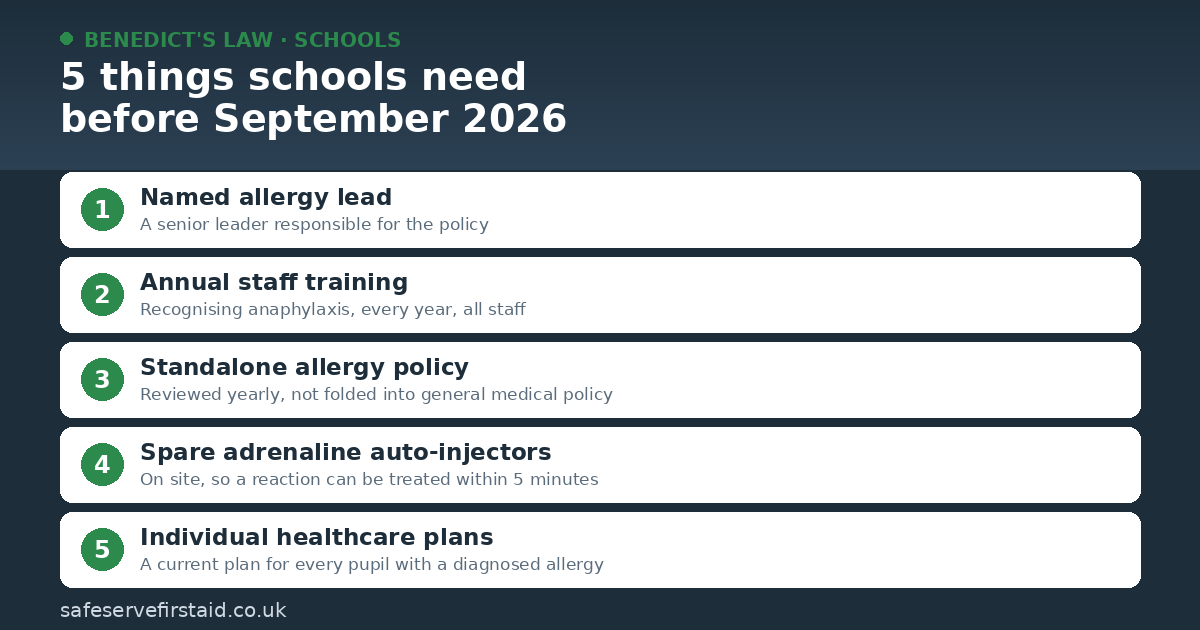
- Annual staff training: all staff need basic allergy awareness and to know how to recognise the signs of anaphylaxis, refreshed every year. The guidance goes further than a general awareness session too, it expects training to cover recognising symptoms, the emergency response, and how to actually use an adrenaline auto-injector, not just knowing one exists.
- A standalone allergy safety policy: it can't be folded into a general medical conditions policy, and must be reviewed at least once a year.
- A named allergy lead: a member of the senior leadership team responsible for the policy, and for improving incident and near-miss reporting and how lessons from them get acted on.
- Spare adrenaline auto-injectors (AAIs): kept on site so a reaction can be treated within 5 minutes, not dependent on a pupil's own device being to hand or in date.
- Individual healthcare plans: a clear, current plan for every pupil with a diagnosed allergy.
An estimated 680,000 pupils in England have an allergy, so this affects most schools whether or not they've had a serious incident before, according to figures cited by Allergy UK.
A practical starting checklist before September
- Name your allergy lead, if you haven't already
- Draft or update a standalone allergy safety policy, separate from your general first aid/medical policy
- Check your current stock and expiry dates of adrenaline auto-injectors
- Book or diarise annual allergy awareness training for all staff, not just first aiders
- Review individual healthcare plans for every pupil with a known allergy
- Set up a simple way to log and review incidents and near-misses, not just serious reactions
If you host school groups or children's parties
Benedict's Law itself only applies to schools, but the same basic risk sits behind plenty of hospitality and leisure venues too: half-term clubs, birthday parties, soft play, school trips to a farm or activity centre, and holiday camps all involve staff who might be the first person to spot a reaction and the last line of defence before an ambulance arrives. None of that is a legal requirement for a venue in the way it now is for a school, but it's worth asking the same five questions of your own team: who's your allergy lead on a shift, when did staff last cover anaphylaxis, do you know where an adrenaline auto-injector is kept if you have one, and does anyone actually check the allergy details a parent gives you at booking.
Where first aid training fits in
Benedict's Law is specifically about allergy awareness and anaphylaxis response, which sits alongside, rather than replaces, your school's wider first aid cover. Recognising and responding to a severe allergic reaction is already part of what we cover on our Paediatric First Aid and Emergency First Aid at Work courses, so if you're refreshing training for staff ahead of September, it's worth timing it alongside your usual first aid requalification rather than as a separate exercise.
This isn't a substitute for whatever specific allergy-lead training the Department for Education ultimately prescribes, and schools should check the full statutory guidance directly. But if you need staff trained or refreshed on recognising and responding to a medical emergency generally, that's exactly what we do, whether you're a school, a nursery, or a hospitality venue that regularly has children on site.
Sources
Related courses
Frequently asked questions
Does Benedict's Law apply to nurseries?
Benedict's Law specifically covers local authority-maintained schools, academies and pupil referral units in England. Early years settings such as nurseries and childminders already have separate allergy and medical-conditions duties under the EYFS framework, and many are choosing to adopt similar practices voluntarily ahead of any future extension.
What training will staff need under Benedict's Law?
The statutory guidance expects all school staff to have basic allergy awareness and to know how to recognise the signs of anaphylaxis, with training reviewed annually. Schools will also need a named allergy lead and a standalone allergy safety policy, reviewed at least once a year.
When do schools need to be compliant with Benedict's Law?
The guidance applies from September 2026. State-sector schools are expected to be compliant by the end of the Autumn Term 2026, and independent schools have until Spring Term 2027.