Mon-Fri 8:00-18:00   Serving Cambridgeshire & the South East
Call 01733 855359  ·  Email us
SafeServe First AidWhere care meets compliance

First aid graphics to print and share.

One-page guides on cardiac arrest, CPR, defibrillators and stroke, free to download.

Next open courses

See all dates and book   Call 01733 855359

Six one-page guides to the topics we get asked about most on our courses. Print them for the staff room or share them with your team. The facts are taken from the Resuscitation Council UK, the British Heart Foundation and the British Red Cross, and the sources are listed on each graphic. Reading is a start. Practising on a manikin is what makes it stick, and that is what our courses are for.

Heart attack or cardiac arrest?

They are not the same thing. A heart attack is a blockage. A cardiac arrest is an electrical problem that stops the heart pumping. This guide shows the difference, what happens to the heartbeat, and what to do for each.

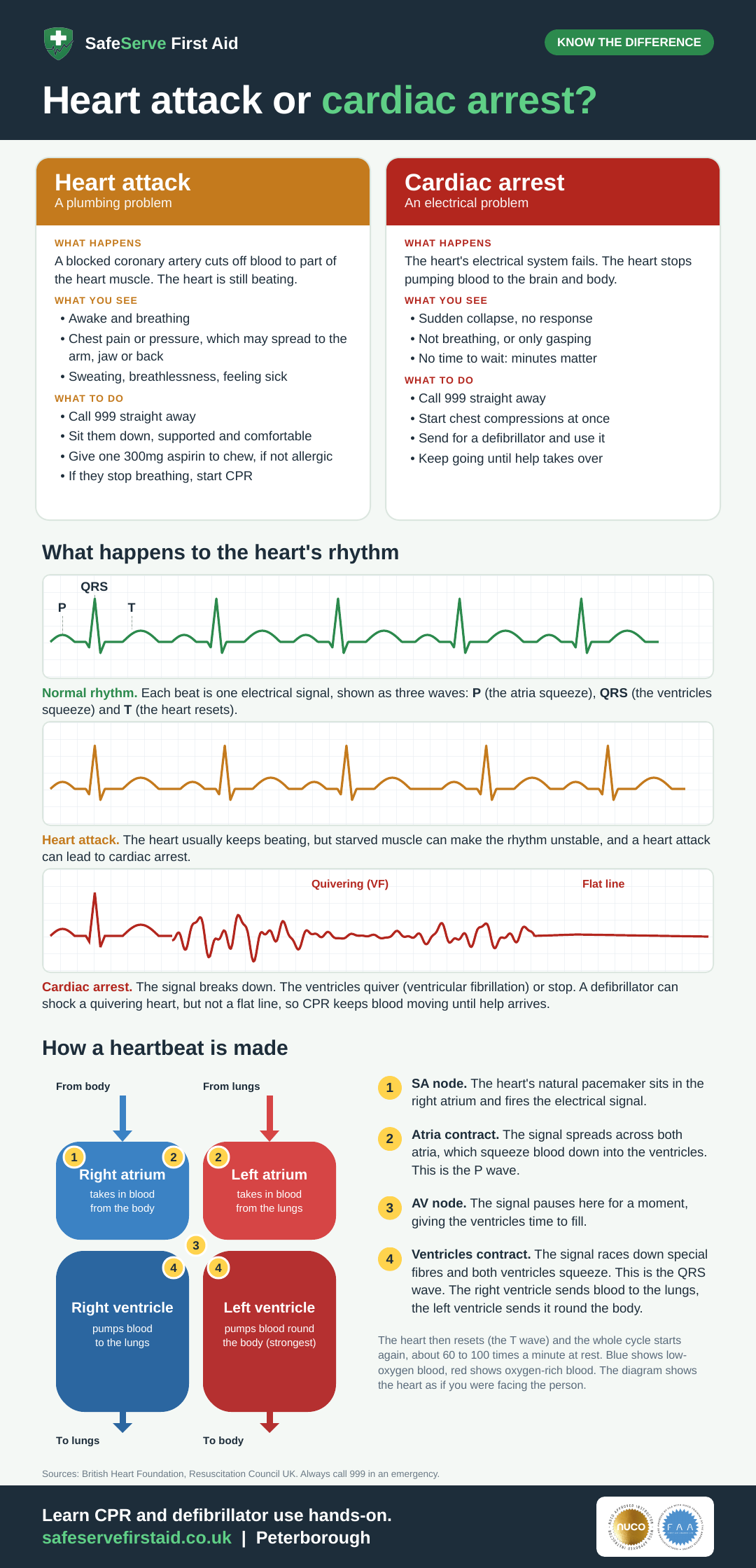
Infographic comparing a heart attack, where blood flow to the heart is blocked, with a cardiac arrest, where the heart stops pumping because of an abnormal rhythm, including what each looks like and what to do.

Download A4 PDF to print   Download image

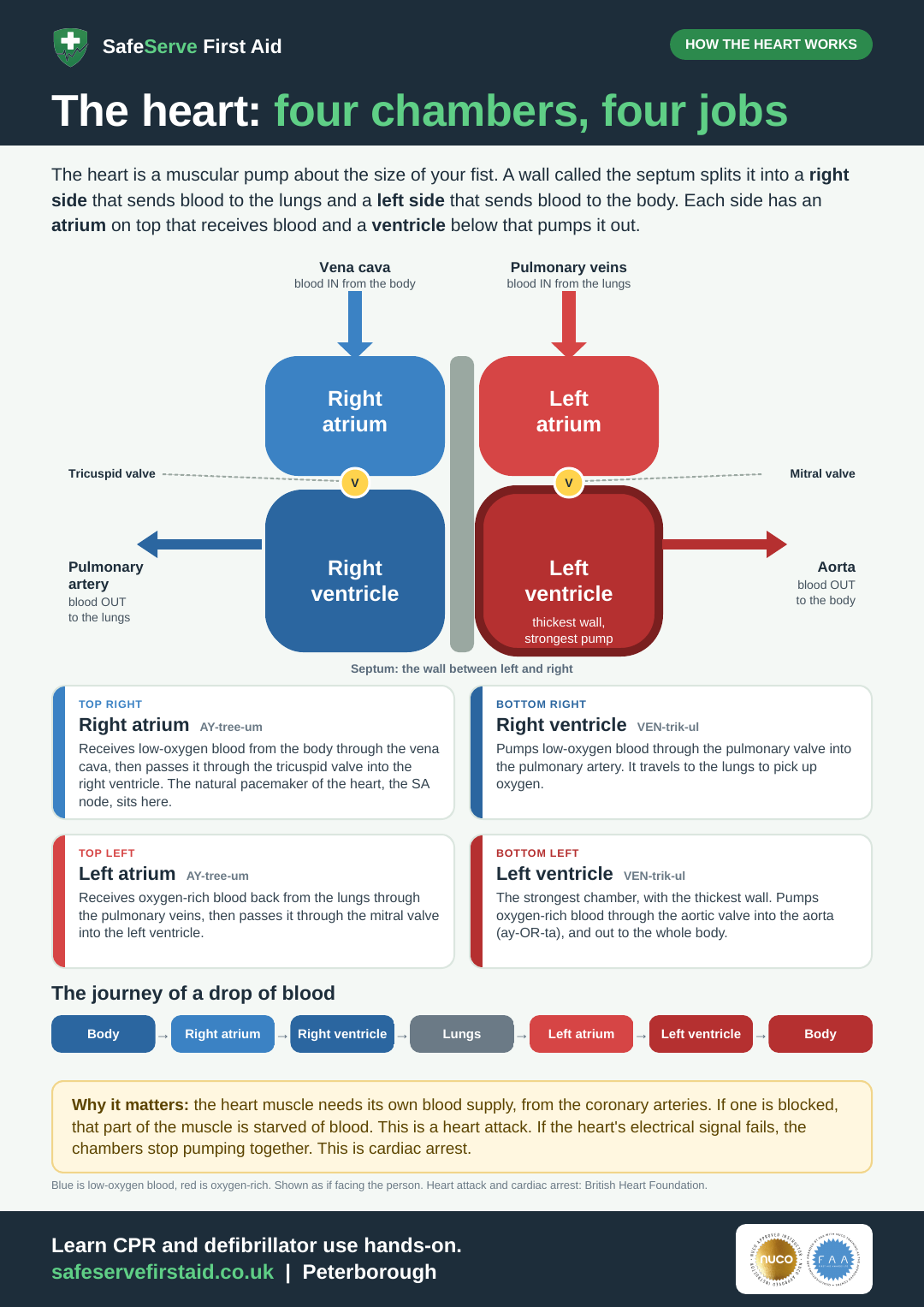
The heart: four chambers and what each one does

The names and jobs of the four chambers, and how the heart makes its own rhythm.

Diagram of the heart showing the right and left atrium and the right and left ventricle, with the job of each chamber and how the heartbeat starts.

Download A4 PDF to print   Download image

What CPR does and how it helps

CPR does not restart the heart. It keeps blood and oxygen moving until a defibrillator can be used and the ambulance arrives.

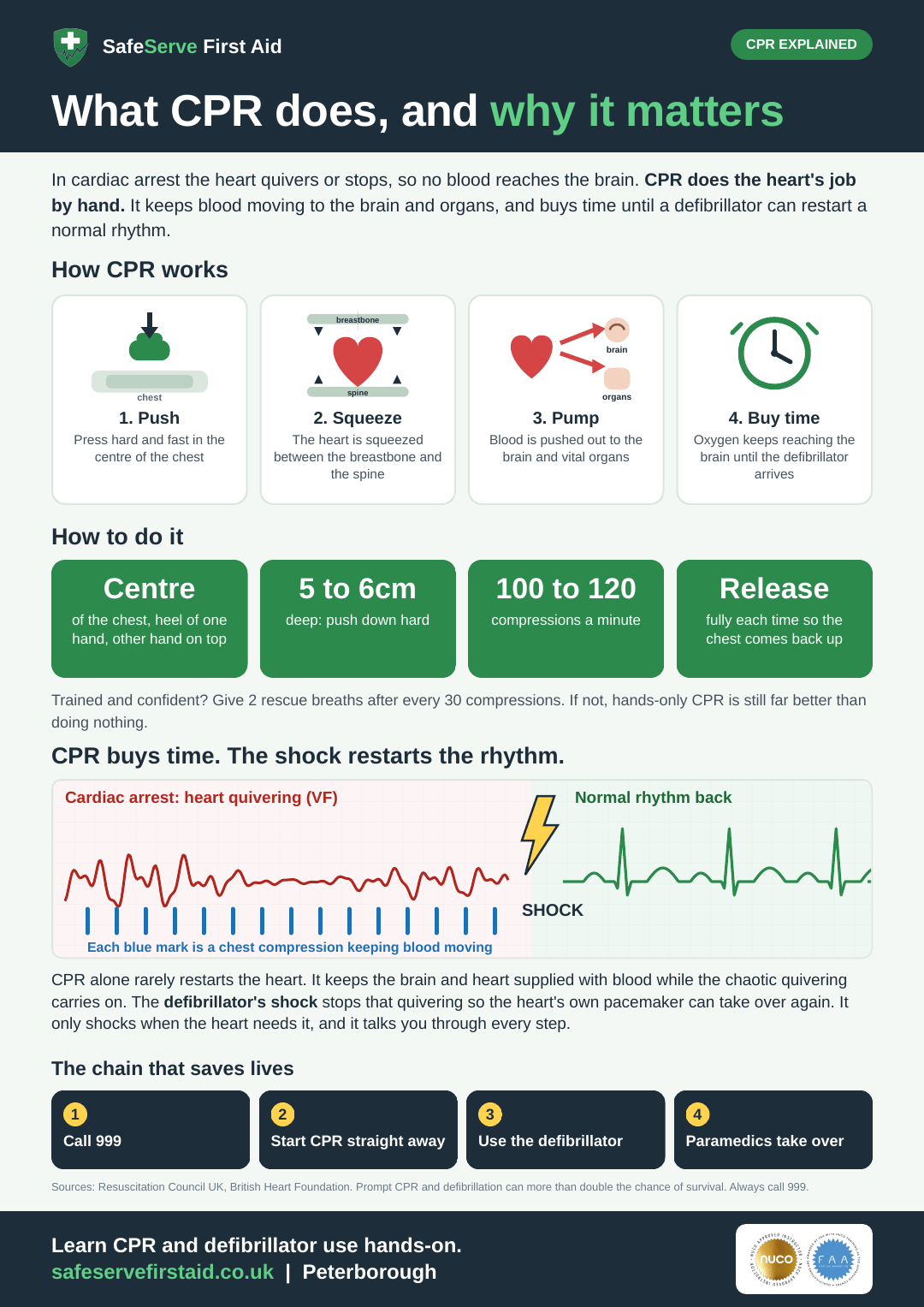
Infographic explaining how chest compressions keep blood moving to the brain and heart until a defibrillator can be used.

Download A4 PDF to print   Download image

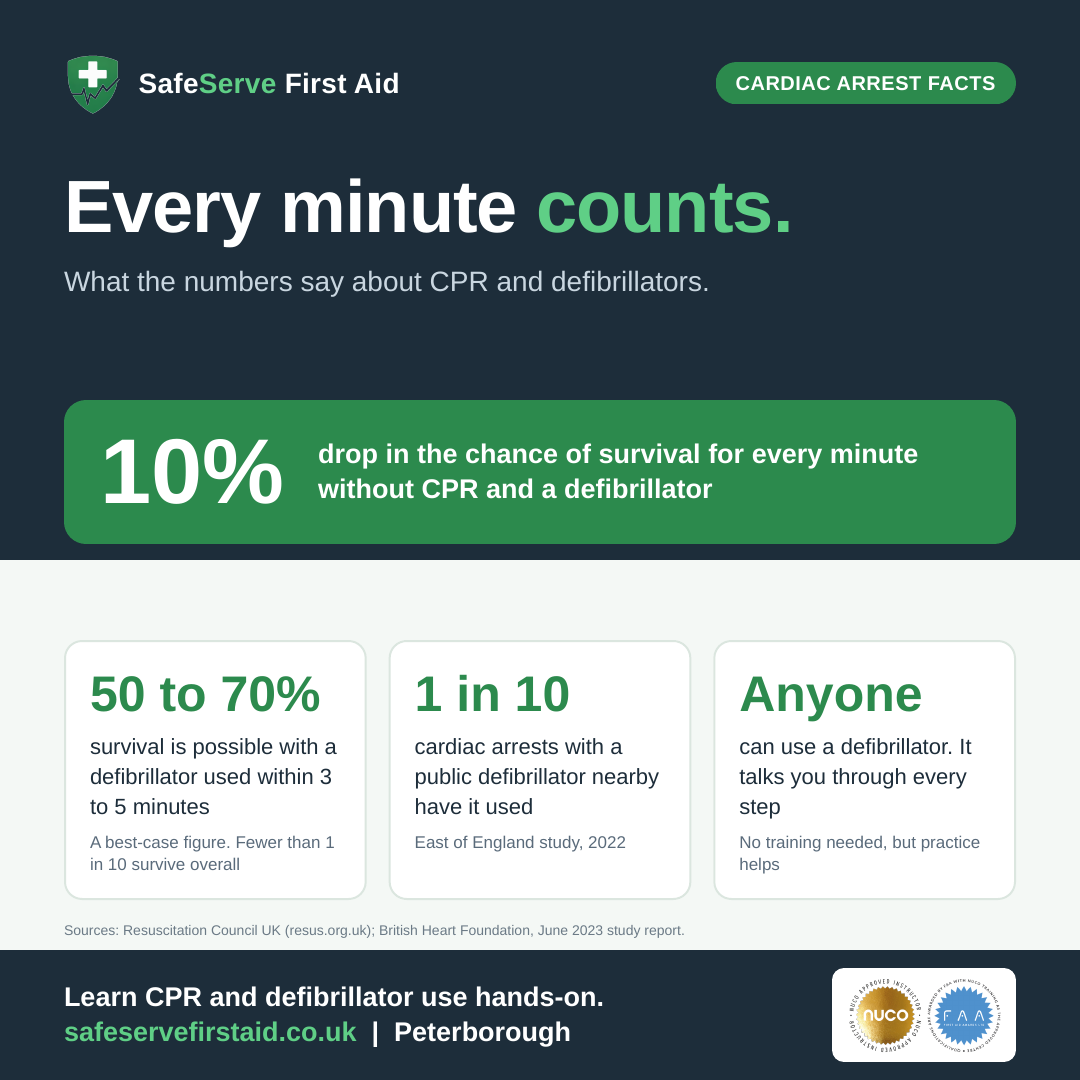
Defibrillator facts

Why every minute counts, and why anyone can use a public defibrillator.

Infographic of facts about defibrillators and survival from cardiac arrest, with sources from the Resuscitation Council UK and the British Heart Foundation.

Download image

Types of bleeding: arterial, venous and capillary

What arterial, venous and capillary bleeding look like, and the first aid steps for heavy bleeding, which are the same for all three.

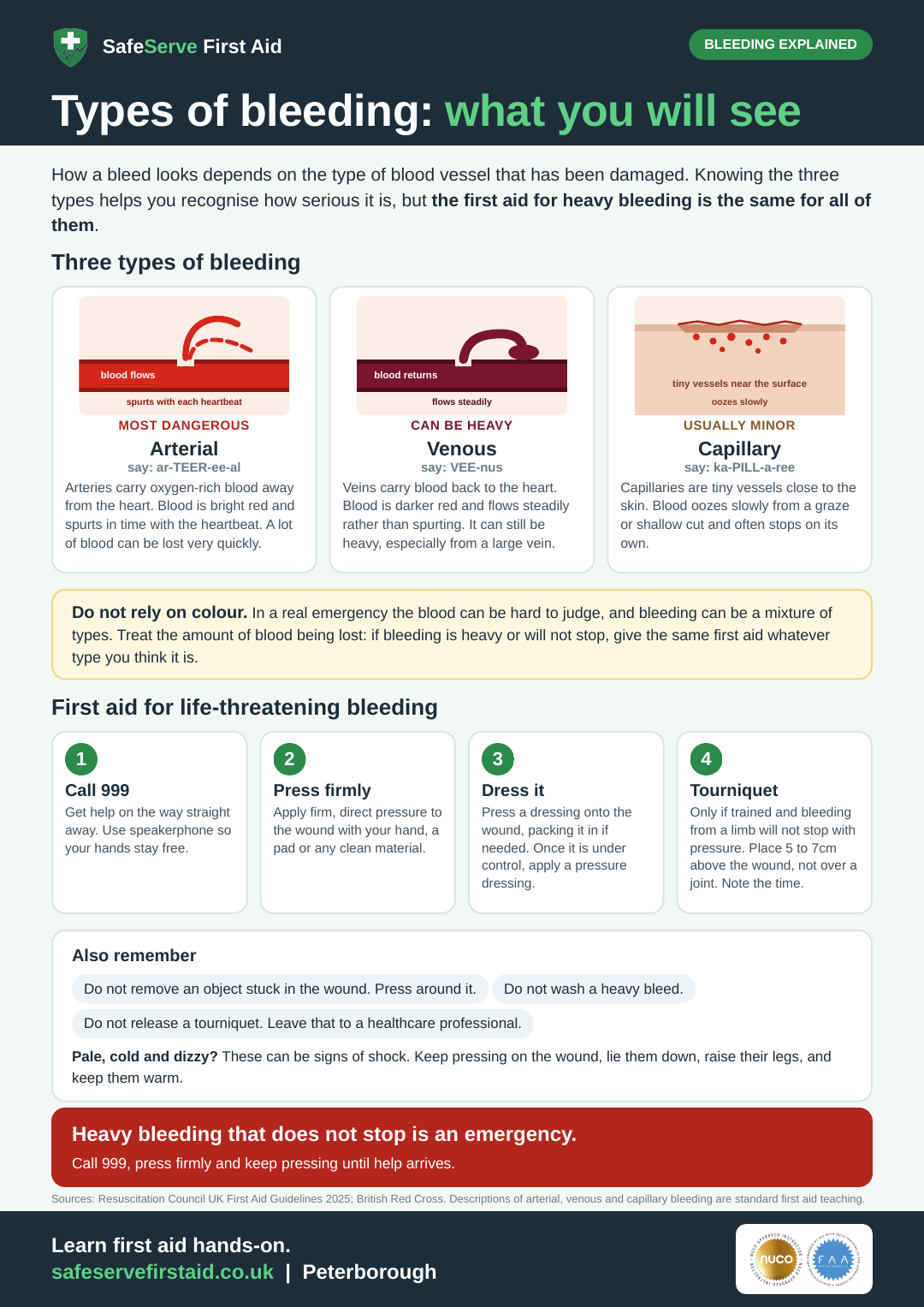
Infographic showing arterial bleeding that spurts bright red blood, venous bleeding that flows steadily in darker red, and capillary bleeding that oozes, with the first aid steps for life-threatening bleeding.

Download A4 PDF to print   Download image

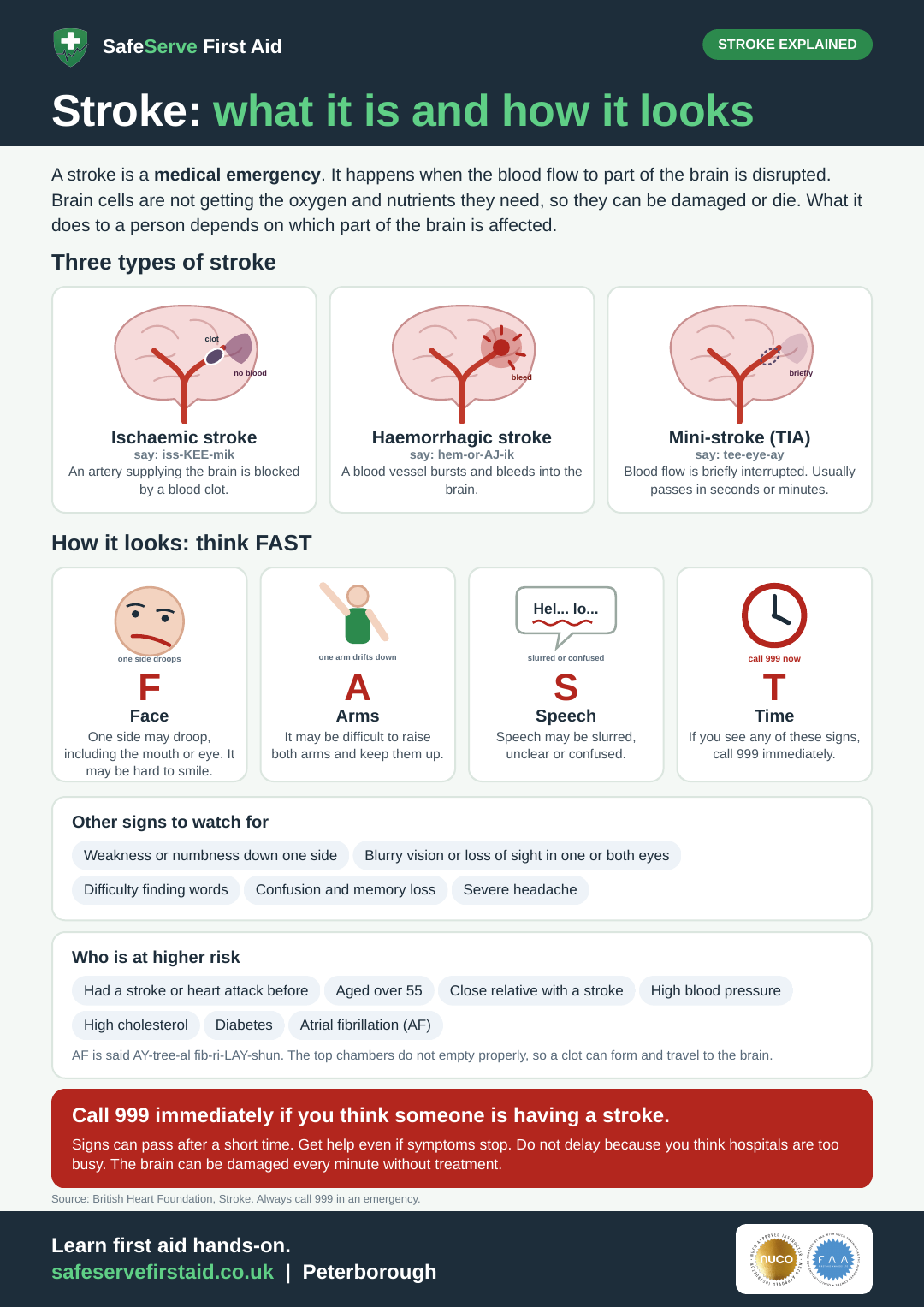
Stroke: what it is and how it looks

A stroke is a medical emergency. Learn the three types, the FAST signs, and when to call 999.

Infographic explaining what a stroke is, the three types (ischaemic, haemorrhagic and mini-stroke), the FAST signs of Face, Arms, Speech and Time, other symptoms, risk factors, and to call 999.

Download A4 PDF to print   Download image

Learn it hands-on

Our Emergency First Aid at Work course covers CPR, defibrillator use, choking, bleeding and recognising a stroke, with practice on manikins. We also run it at your workplace for teams of 5 to 12. See group first aid training.

These guides are general information and do not replace a first aid course. In an emergency, call 999.

Related pages

Book an upcoming course

Reserve your place online, or enquire about any course, a group booking at your workplace, or a date that suits you.

Enquire about a course   Call 01733 855359   See all dates

Ready to book a regulated course?

Tell us your course and headcount, and we'll come back with dates and confirmation within 1 working day.

Request a quote See pricing
Book a courseCall 01733 855359